When Stress Becomes Your Normal, How Do You Know You're Okay?
We train to help other people through demanding situations. We learn how to solve problems, make decisions under pressure, and support others when things get difficult.
But where do we learn the skills to manage ourselves?
In emergency management, public safety, nonprofits, and other mission-driven fields, stress often comes with the job. Over time, we can become remarkably good at working through it. Long hours, competing priorities, and constant demands may start to feel ordinary.
That ability to keep going can be a strength. But it also raises an important question: When stress becomes our normal, how do we recognize when it's affecting us?
That's one of the questions I explored with psychiatrist and psychotherapist Peter Wehmeier in the first episode of Worth Exploring, an EM Wellness conversation series.
When High Stress Starts Feeling Ordinary
Think about someone who regularly works long hours, responds to problems after hours, and moves from one urgent issue to the next. At first, the demands may feel overwhelming. Eventually, they become more comfortable operating at that pace.
They may even feel like they're doing fine. After all, they're still getting the work done.
But what if they're sleeping less, becoming more irritable, or finding it harder to disconnect? What if those changes happen so gradually that they barely notice?
During our conversation, Peter emphasized the importance of recognizing our own normal, including our personal limits. This can be difficult in workplaces where high stress is common and everyone around us seems to be managing similar demands.
Being able to function under pressure doesn't necessarily mean the pressure isn't affecting us.
The World Health Organization identifies exhaustion, growing distance or negativity toward work, and reduced professional effectiveness as dimensions of occupational burnout. Burnout is specifically associated with chronic workplace stress that hasn't been successfully managed. It isn't a medical diagnosis or a label for every stressful experience.
The point isn't to assume we're burned out whenever we're tired. It's to notice changes before they become our new baseline.
Self-Management Is More Than Self-Care
Peter's work focuses on effective self-management, which goes beyond the activities we often associate with self-care.
His approach explores five connected dimensions:
- Awareness: Recognizing what's happening within and around us, including our needs and limits.
- Relationships: Building and maintaining meaningful connections with others.
- Future perspective: Looking ahead, identifying priorities, and considering where we want to go.
- Decision-making: Making choices about how to respond rather than simply reacting.
- Effective action: Following through on decisions and adjusting when needed.
Consider someone managing a demanding project. They may recognize that they're exhausted (awareness), talk with a trusted colleague (relationships), reconsider what needs to happen this week (future perspective), decide what can wait (decision-making), and adjust their schedule or ask for additional support (effective action).
Of course, not every situation gives us that flexibility. Sometimes the workload cannot wait, staffing is limited, or the demands are outside our control.
Still, the five dimensions offer a way to think about how we respond within those constraints.
Peter and his research colleagues also developed the Self-Management Self-Test (SMST), a brief tool designed to assess self-management competence. Their published validation study provides evidence supporting the measure in the populations studied.
An important distinction: a screening or self-assessment tool isn't a diagnosis. It can provide information worth exploring, but it cannot replace a professional assessment or explain every reason someone may be struggling.
What Feels Good Isn't Always What Helps
One part of our conversation that I pushed Peter to discuss further, was the difference between something that feels good in the moment and something that's actually helpful over time.
After a difficult day, we may want to escape, disconnect, or do something that brings immediate relief. Sometimes that's exactly what we need. Other times, our usual way of coping may leave us feeling worse later.
For example, enjoying a meal with friends after a stressful week can support connection and recovery. But regularly using food or alcohol to avoid dealing with stress may create additional problems. The distinction isn't about judging the activity. It's about understanding its purpose and its impact.
Are we making a conscious choice that helps us recover, or have we developed an automatic response that no longer serves us?
That's a question worth asking without turning every enjoyable activity into something we need to analyze. Rest, fun, and occasional indulgence have their place, too.
Practice Before You Need It
Another idea we discussed was the importance of practicing self-management skills before we're in the middle of a difficult situation.
I think about it like learning to play basketball. You can understand how to shoot, watch someone demonstrate it, and explain the technique. But that doesn't mean you'll make the shot when the pressure is on.
You need practice.
The same applies to recognizing our limits, asking for support, making decisions, and changing our behavior. These are skills we can work on during ordinary days, not just during a crisis.
In emergency management, we often talk about preparing during blue sky so we're better equipped when gray sky arrives. Why wouldn't we apply that same thinking to ourselves?
That doesn't mean we'll always get it right. It means we have a better chance of recognizing what's happening and responding intentionally when demands increase.
And individual skills are only part of the picture. Staffing, schedules, workload, and workplace culture all influence how much control people have over their circumstances. Organizations still have a responsibility to address working conditions that create unnecessary or ongoing stress.
A Question Worth Asking
If stress has become part of your normal routine, it may be worth looking beyond whether you're getting everything done. Think about how things have changed over the past few months:
- Are you recovering from demanding periods?
- Have your sleep, patience, or relationships changed?
- Do you have people you can turn to?
- Are you choosing how to spend your energy, or mostly reacting to whatever comes next?
These aren't diagnostic questions. They're an invitation to notice what may be easy to overlook. There's nothing inherently wrong with working hard, taking on demanding assignments, or choosing to push yourself for something that matters.
But being accustomed to stress and being well-supported through it aren't necessarily the same thing.
Recognizing that difference is one place to start. Learning what to do with that awareness is another.
In my conversation with Peter, we explore both, along with how self-management skills can be practiced before we find ourselves in another demanding situation.
Continue Exploring
Watch: Worth Exploring: Self-Management Under Stress, my full conversation with Peter Wehmeier. Watch on YouTube
Explore the research: Self-Management Self-Test (SMST) development and validation study. The study examines the measure's development and validity; it does not establish that the test diagnoses burnout or that self-management training prevents it.
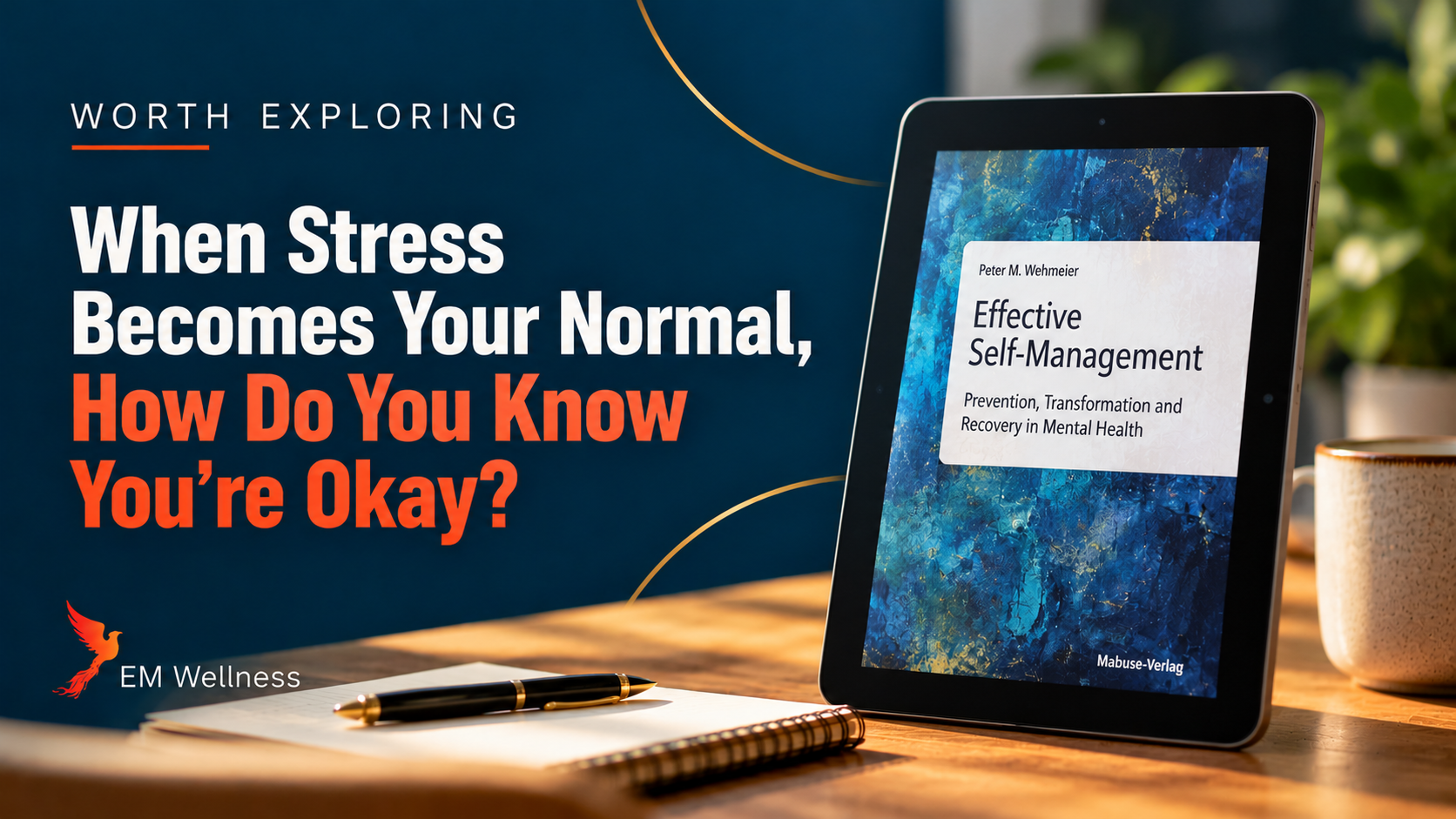
Read Peter's book: Effective Self-Management: Prevention, Transformation and Recovery in Mental Health (2026).
Connect with Peter: LinkedIn
Worth Exploring is an EM Wellness series of informal, curiosity-led conversations about people's work, ideas, experiences, and perspectives.
This article and conversation are for general education, not individual medical advice. Screening is not a diagnosis or a substitute for professional assessment.