When High Performance Becomes Unsustainable
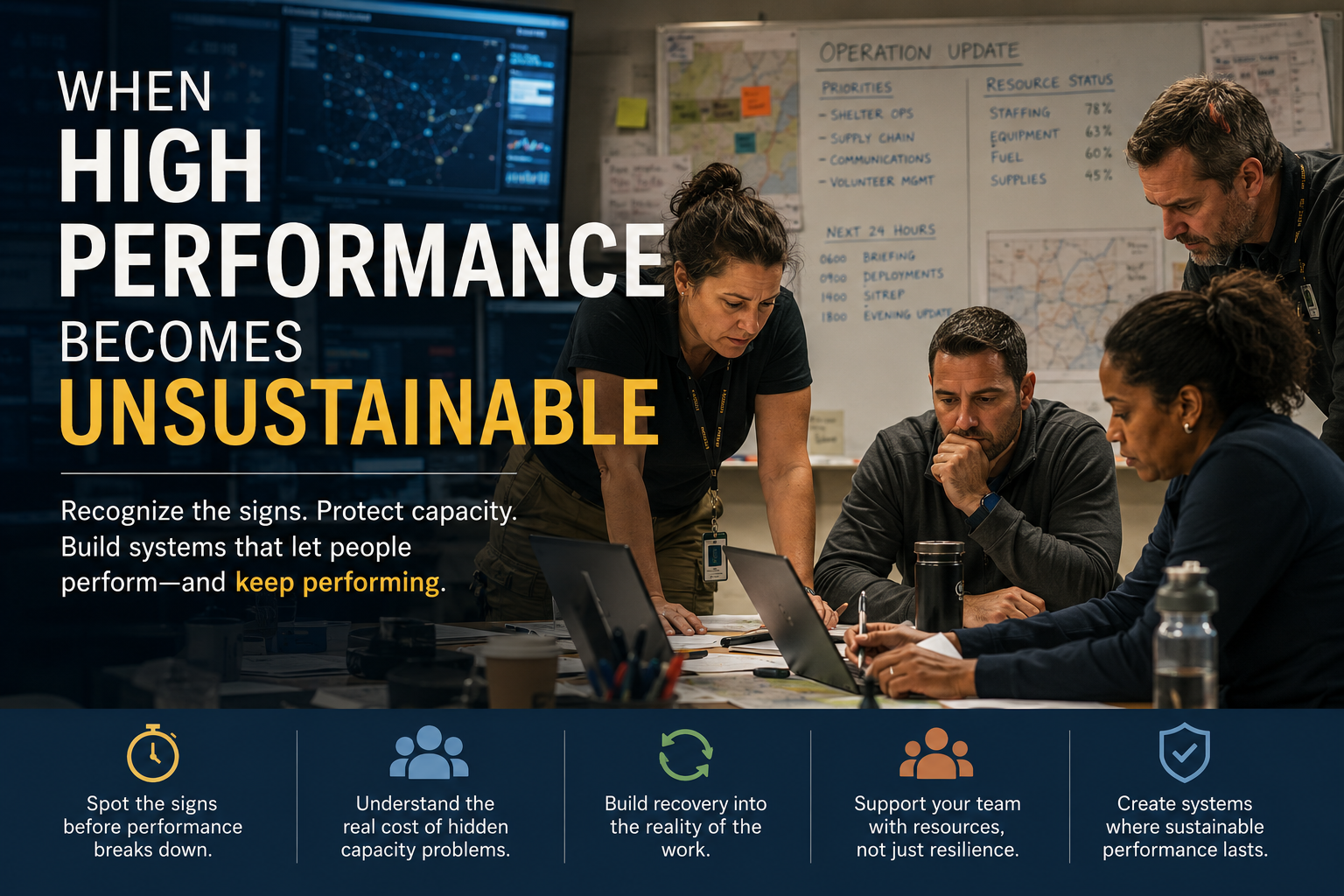
What does it actually take to keep your team performing at a high level? Who is quietly filling the gaps when the workload exceeds the resources available? And what happens when that person can no longer do it?
High-performing teams can look successful right up until they aren’t. The deadlines are met. Problems get solved. The client gets what they need. When something falls through the cracks, someone catches it. When there is too much work, someone stays late. When a new problem appears, someone figures it out.
From the outside, the system appears to be working. But is it sustainable?
I’ve worked in schools, nonprofits, emergency management, and other mission-driven environments, and I’ve seen versions of this pattern again and again. The people drawn to this work tend to care deeply about what happens if something does not get done. Sometimes, the consequences are very real.
If we cannot figure out staffing for a new disaster, it can slow the response. If a client can only talk after normal working hours, there may be a legitimate reason to take that call. If you are running a small business, not working can quite literally mean not making money.
Caring about the outcome, anticipating cascading impacts, and having empathy for the people affected by our decisions are professional strengths. But those same strengths can make it remarkably easy to compensate for a system that is asking for more than it can sustainably support.
The challenge for leaders and organizations is learning to recognize the difference.
A Demanding Job Isn’t Necessarily an Unsustainable One
Not every difficult period at work is inherently unhealthy. The Job Demands-Resources model, an established framework in occupational-health research, considers not only what a job requires from people but also the resources available to help them meet those demands. Those resources can include autonomy, supervisor and peer support, adequate staffing and tools, clear expectations, and opportunities to recover.
That distinction matters because similar levels of workload can produce very different outcomes depending on the resources surrounding the work. It is also why I do not think the goal should be to eliminate every period of intense work, but to ensure that sustained demands are matched with adequate resources and recovery.
There are times when I have knowingly chosen to push harder. A major project is launching. A disaster requires long hours. I’m at a conference and decide that staying up late talking with colleagues is worth being tired the next morning. Those are conscious choices made for a reason.
When did the exception become the operating model?
Working until midnight once to get an important project across the finish line is different from regularly working until midnight because there is no other way to keep up. Taking an after-hours call because circumstances require it is different from becoming the person who is always available because everyone has learned that you will be.
At some point, a strategic choice can quietly become an organizational expectation.
Wellness Action: Look back at the past 30 days. Identify one behavior you consider an “exception” – working late, skipping lunch, answering messages after hours, or covering someone else’s responsibilities. How many times did it actually happen? The frequency may tell you whether it is still an exception.
High Performance Can Hide a Capacity Problem
High performers can become remarkably good at functioning in unsustainable systems. They compensate. They remember what the process does not. They work longer, answer the message, cover the vacancy, catch the mistake, and become the backup plan.
And because the work keeps getting done, the organization receives a powerful signal:
This is working.
But output only tells us that the work got done. It does not tell us what people had to spend to make that happen. This is particularly important in mission-driven organizations. The more people care about the outcome, the easier it becomes for individual commitment to compensate for inadequate organizational capacity.
The National Institute for Occupational Safety and Health (NIOSH) similarly frames job stress as more than an individual’s ability to cope. It considers the relationship between the requirements of the job and the worker’s capabilities, resources, and needs.
That changes the question. Instead of only asking, “How can this person become more resilient?” leaders also need to ask, “What is this environment repeatedly requiring from them?”
Leaders can start by looking beyond traditional measures of performance:
- Who consistently stays late to finish the work?
- Who carries information that is not documented anywhere?
- Who catches mistakes before anyone else sees them?
- Who has quietly absorbed responsibilities from vacant positions?
- Who has become the unofficial backup plan?
- What happens if that person is unavailable tomorrow?
If one person’s extraordinary effort is routinely required for normal operations, that effort is no longer simply high performance. It may be masking a capacity problem.
Wellness Action: Identify one person your team would struggle to operate without for a week. Ask what knowledge, tasks, relationships, or responsibilities are concentrated with that person. Then identify one step you can take to reduce that dependency.
Watch for the Signs Before Performance Drops
The World Health Organization defines burn-out as an occupational phenomenon resulting from “chronic workplace stress that has not been successfully managed”. Chronic is an important word.
A difficult week is not necessarily evidence of an unhealthy workplace. Neither is a demanding project, a major event, a disaster response, or an occasional late night. The more important question is whether those periods remain temporary.
Do people return to something resembling normal afterward? Can they actually recover? Are there enough people and resources to do the work? Or does one surge simply roll into the next?
We often expect unsustainable work to announce itself dramatically. Someone burns out. A major mistake happens. A key employee quits.
In my experience, the earlier signs can be much smaller. People get a little snappier. Sleep gets sacrificed. Food becomes whatever is quickest because there is not much energy left to think about it. People do not bounce back as quickly after being sick. Someone who normally has patience for a problem suddenly has very little left.
Even with these quieter signs, they may still be doing excellent work.
There is good reason to pay attention before performance noticeably declines. OSHA’s worker-fatigue guidance identifies long work hours, understaffing, workload, and worker absences among organizational contributors to fatigue.
The research on stress and cognition is more nuanced than the common claim that “stress makes you a bad decision-maker.” Different circumstances and cognitive functions can produce different effects. However, a review of research on acute stress and executive function found that acute stress generally impaired working memory and cognitive flexibility, while its effects on inhibition were more complicated.
That is one reason it’s worth talking more precisely about cognitive demands, stress, and decision quality rather than casually labeling everything “decision fatigue.” The larger lesson is simpler: We should not have to wait for someone’s performance to collapse before we are willing to ask whether the demands of the work have become a problem.
Wellness Action: During your next team check-in, ask something more useful than “How are you?” Try: “What is taking more energy than it should right now?” Listen for recurring obstacles rather than immediately trying to solve individual coping.
Build Recovery Into the Reality of the Work
This is where a lot of workplace wellness advice loses me.
Get enough sleep. Disconnect from work. Take your breaks. Learn to say no. Protect your time. All reasonable advice. This advice does not match the reality of high-paced, mission-critical, non-9-to-5 work.
During the COVID-19 response in New York City, I was not going to solve the demands of the response by deciding I needed a better evening routine. There were days when the realistic opportunity for recovery was much smaller. So I started thinking about what I call “micro moments”.
I had about a two-minute walk to the subway. Sometimes I used those two minutes to call home. I had already told my family what I needed: I did not want to talk about the response. I wanted to hear about their day.
For two minutes, I could step outside the reality that had consumed almost everything around me and remember there was an entire world continuing beyond it. It did not fix the workload. It did not replace sleep. It did not make an unsustainable system sustainable.
But it helped keep me grounded.
On one particularly difficult day, I asked someone to watch the phone for five minutes. I went down to the locker room and sat by myself. There was not enough time to solve anything. I breathed, processed what had happened, composed myself, and went back upstairs. Those five minutes were not about escaping the work. They helped me return to it as a better version of myself than I would have been without them.
Research gives us reason to take these small opportunities seriously. A review of recovery-from-work research examines the role of recovery experiences, including psychologically disengaging from work, in employee well-being. More recent research on recovery during work breaks has also examined how opportunities for recovery during the workday relate to employee outcomes.
In practice, micro moments can be simple:
- Take a five-minute walk without your phone.
- Call someone and talk about anything except work.
- Sit somewhere quiet between meetings or operational periods.
- Eat lunch away from your workstation, even if you only have 10 minutes.
- Put one transition between work and home – music, a walk, changing clothes, or a few minutes without another input demanding your attention.
But there is an important caveat: Micro moments should never become an excuse for macro problems. A five-minute reset cannot fix chronic understaffing. A breathing exercise cannot create backup capacity. Calling someone you love does not make a 70-hour workweek sustainable.
Individual practices can help us navigate demanding conditions. They cannot absolve organizations from examining why those conditions persist.
Wellness Action: Identify two realistic micro-recovery opportunities that fit the work you actually do – not the wellness routine you think you are supposed to have. Leaders should also identify one way to protect those opportunities for their teams.
High Performance Should Not Depend on Heroics
The people who care the most about the work are often the ones most willing to stretch themselves to make sure it gets done. That commitment can be an incredible asset during a crisis, a launch, a difficult season, or any moment when the stakes are high.
But commitment is not the same thing as unlimited capacity.
If an organization consistently depends on people working beyond reasonable limits, carrying undocumented knowledge, filling staffing gaps, or sacrificing recovery just to maintain normal operations, the problem is no longer individual resilience. It is how the work has been designed and resourced.
That is why sustainable performance requires attention at every level. Individuals need permission to recognize when an exception has become a pattern. Managers need to notice the invisible effort behind the results they see. Organizations need to build enough capacity, redundancy, and recovery into the system that extraordinary effort can remain exactly that: extraordinary.
There will still be times when we step up. I hope there are. Some of the work that matters most will always ask more from us at certain moments.
The goal is not to create workplaces where no one is ever tired, stretched, or asked to do something difficult. The goal is to create workplaces where people can give more when it truly matters because we have not already asked them to give everything, every day.
That is the difference between a team that can perform at a high level today and one that can still perform at a high level tomorrow.